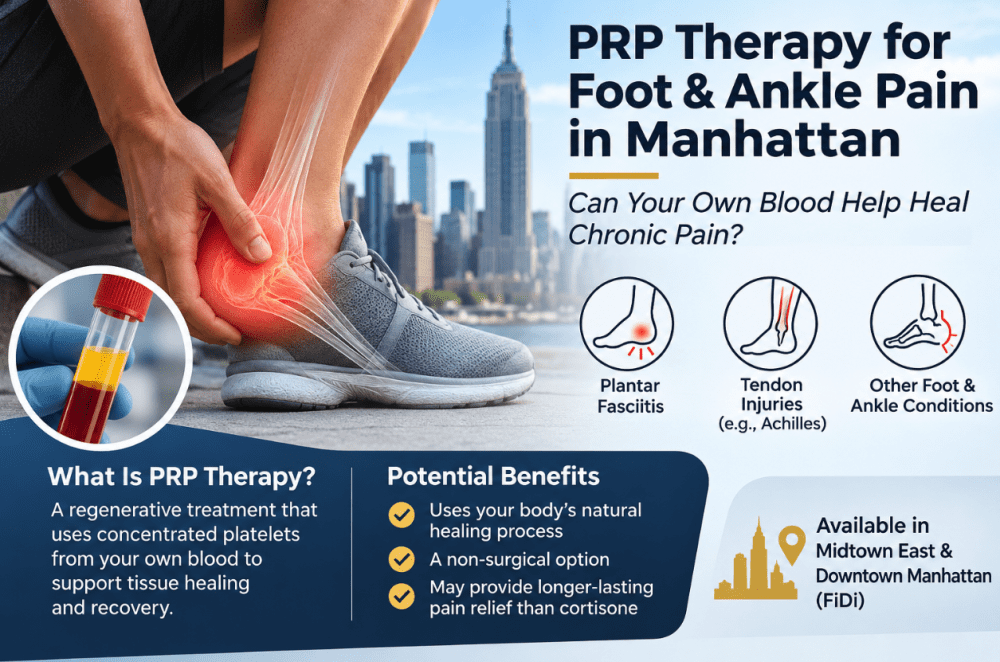
Understanding PRP Therapy for Foot and Ankle Pain in NYC
If you've been struggling with persistent heel pain, tendon injuries, or chronic foot and ankle discomfort, you know how frustrating it can be when conventional treatments don't provide lasting relief.
Rest, ice, medications, orthotics, and physical therapy are often effective. But what happens when the pain continues despite these treatments?
One option receiving considerable attention in sports medicine and podiatry is Platelet-Rich Plasma (PRP) therapy, a treatment that uses components of your own blood to support the body's natural healing processes.
At Manhattan Podiatry Associates, with offices in Midtown East and Downtown Manhattan's Financial District (FiDi), we believe patients should understand their treatment options, including the potential benefits and limitations of regenerative medicine. Learn more about our Platelet-Rich Plasma (PRP) therapy in NYC.
What Exactly Is Platelet-Rich Plasma (PRP) Therapy?
To understand PRP, it helps to understand how your body normally heals an injury.
Your blood contains red blood cells, white blood cells, plasma, and platelets. While platelets are best known for helping blood clot, they also contain proteins called growth factors, which participate in tissue repair and healing.
When an injury occurs, platelets become activated and release growth factors that help coordinate the body's response to damaged tissue.
PRP therapy takes advantage of this natural process.
During treatment, a small amount of blood is drawn from your arm and placed into a specialized centrifuge. The centrifuge separates the blood into its components, allowing the platelet-rich portion to be collected.
This concentrated preparation is then injected into the targeted area of injury.
The goal is to deliver a higher concentration of platelets and their associated growth factors directly to tissue that may be struggling to heal.
Unlike corticosteroid injections, which primarily work by reducing inflammation, PRP is intended to influence the biological processes involved in tissue repair.
Patients researching PRP injections for foot and ankle pain in Manhattan can learn more about this treatment approach through Manhattan Podiatry Associates.
What Foot and Ankle Conditions Might Benefit From PRP Therapy?
PRP has been investigated for several musculoskeletal conditions. In podiatry, particular attention has been given to chronic plantar fasciitis and certain tendon disorders.
PRP Therapy for Plantar Fasciitis and Chronic Heel Pain
Plantar fasciitis is one of the most common causes of heel pain. The plantar fascia is a thick band of connective tissue extending from the heel toward the toes.
Repetitive stress can lead to microscopic tissue damage and degenerative changes, particularly when symptoms become chronic.
For patients who haven't responded adequately to stretching, orthotics, physical therapy, or other conservative treatments, PRP may offer another option.
For individuals experiencing persistent heel pain in Midtown Manhattan or the Financial District, PRP therapy for chronic foot and heel pain may be worth discussing during a podiatric evaluation.
PRP Therapy for Achilles Tendon Disorders
The Achilles tendon connects the calf muscles to the heel bone and is subjected to substantial forces during walking, running, and exercise.
Chronic Achilles tendinopathy can involve degeneration of tendon fibers rather than simply inflammation.
The biological theory is that these growth factors will restart a stalled healing process in the hypovascular (low-blood-supply) midportion of the Achilles tendon.
Other Tendon, Ligament, and Joint Conditions
Researchers have also investigated PRP for ligament injuries, other chronic tendon disorders, and arthritis.
However, evidence for many specific foot and ankle conditions remains limited. A thorough examination and accurate diagnosis are essential before deciding whether PRP is appropriate.
PRP vs. Cortisone Injections for Heel Pain: What's the Difference?
Many patients are familiar with cortisone injections, particularly for painful heel conditions.
Cortisone is a powerful anti-inflammatory medication. It can provide relatively rapid relief, but its effects may be temporary, and repeated injections in certain tissues carry risks.
PRP works differently. Rather than delivering a steroid medication, it uses concentrated components of the patient's own blood in an attempt to support tissue recovery.
Interestingly, a 2025 systematic review and meta-analysis of 24 randomized clinical trials involving more than 1,600 participants found that PRP provided better pain relief than corticosteroid injections at three and six months in patients with plantar fasciitis.
The appropriate treatment depends on the diagnosis, severity of symptoms, previous treatments, and individual patient circumstances.
What to Expect During and After PRP Treatment in Manhattan
PRP is generally performed as an outpatient procedure, without surgical incisions.
After the blood is collected and processed, the concentrated platelet preparation is injected into the affected area. Ultrasound guidance may be used when appropriate to improve the accuracy of injection placement.
Patients may experience temporary soreness, swelling, or increased discomfort following treatment.
Unlike an injection designed to provide immediate pain relief, PRP generally requires patience. Some individuals notice improvement over several weeks, while others may require several months to assess their response.
A temporary reduction in strenuous activity may be recommended, followed by a gradual return to normal activities.
PRP is often most appropriately consideredas part of a comprehensive treatment plan that may include rehabilitation, supportive footwear, custom orthotics, and correction of underlying biomechanical abnormalities.
As with any injection, there are potential risks, including bleeding, infection, nerve injury, and the possibility of no improvement.
For patients considering PRP treatment at Manhattan Podiatry Associates, a consultation can help clarify what to expect and whether the procedure is appropriate.
Is PRP Therapy Right for Your Foot and Ankle Pain?
One of the most important aspects of treating persistent foot and ankle pain is identifying why the condition developed and why it hasn't improved.
For example, chronic plantar fasciitis may be associated with tight calf muscles, abnormal foot mechanics, repetitive overload, or inappropriate footwear.
Addressing these contributing factors is essential, regardless of whether PRP is used.
Patients should also recognize that not all foot pain originates from a tendon or ligament problem. Stress fractures, nerve entrapment, arthritis, and other conditions may produce similar symptoms but require very different treatment approaches.
PRP Therapy Consultations in Midtown East & the Financial District
Living with chronic foot pain can affect far more than your ability to exercise. It can interfere with your commute, workday, recreational activities, and overall quality of life.
The encouraging news is that advances in diagnostic imaging, biomechanics, rehabilitation, and regenerative medicine continue to expand the options available to patients.
At Manhattan Podiatry Associates, with locations in Midtown East and Downtown Manhattan's Financial District (FiDi), our goal is to identify the underlying cause of your symptoms and develop an individualized treatment plan.
Our Midtown East office at 133 East 54th Street serves patients throughout Midtown Manhattan and surrounding neighborhoods, while our Downtown office at 65 Broadway provides convenient access for patients in the Financial District, Wall Street, and Lower Manhattan.
If you've been experiencing persistent heel pain or another foot and ankle condition that hasn't improved with conventional treatment, a comprehensive evaluation can help determine whether PRP or another treatment approach may be appropriate.
Learn More About Platelet-Rich Plasma (PRP) Therapy at Manhattan Podiatry Associates
Because getting back on your feet begins with understanding what's keeping you off them.
Manhattan Podiatry Associates, PC - Midtown East & Downtown Manhattan (Financial District), New York City.
This article is intended for educational purposes and does not replace an individualized medical evaluation.
Author
Dr. Mark J. Landsman
Fellow, American College of Foot and Ankle Surgeons; Board Certified in Foot and Ankle Surgery